

Peaches and dreams
 More online: Recipes and shopping tips
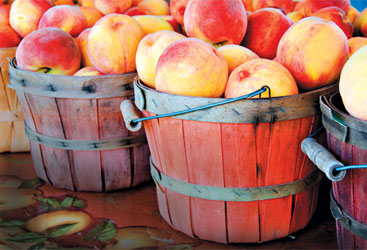
A sweet staple popular even before the Gold Rush, the cling peach has long been appreciated for its ability to be enjoyed year-round. Canned, bottled or packed in snack-sized cups, today's canned peach remains a source of satisfaction among consumers worldwide and the California families who stand behind the quality of the golden fruit.
"It has been a longtime, family goal to harvest the best quality fruit so that it can be consumed at any time during the year," said Justin Micheli, a fourth-generation farmer in Sutter County.
Micheli and his cousin Anthony Laney manage separate farms in the community of Live Oak, but share a love for the land passed down through generations.
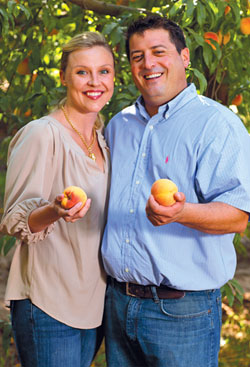
Fourth-generation farmer Justin Micheli and his wife Candice grow cling peaches in Sutter County. This firmer variety of peach is typically canned, jarred or packed into kid-friendly fruit cups.
"At a very early age, if I wasn't riding the tractor with my dad, I'd spend time with my grandfather in his pickup learning about farming," said Micheli, named for his 96-year-old grandfather who started farming the property in 1946. "It was not uncommon for my father to give us a project, from painting trees (to prevent sunburn) or tying rope. The reward of being able to drive the three-wheeler at the end of the day was enough motivation to spend a lot of hours on the ranch."
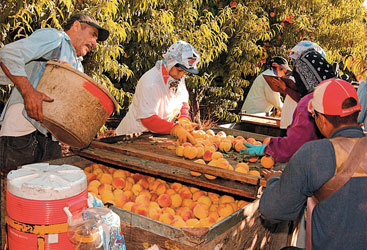
California's crop of cling peaches is hand-harvested from June to September and then sorted in the orchard.
Laney said he, too, benefited from the advice and hands-on opportunities provided by the older generations.
"When I bought my orchard, Justin's grandfather taught me how to prune," Laney recalled. "He showed me what a tree should look like. Here's an 88-year-old guy, in 50-degree weather in fog, helping me prune peach trees."
Laney and Micheli trace their Sutter County roots back to their grandfathers' uncle, Addenaco "Dan" Pasquini, who began farming in the area during the 1920s and, in 1930, purchased property that became Pasquini's Grocery and Gas Station. He invited his three nephews—Anthony's grandfather, Justin's grandfather (Justin Micheli I) and his twin brother Roy—to lend a hand.
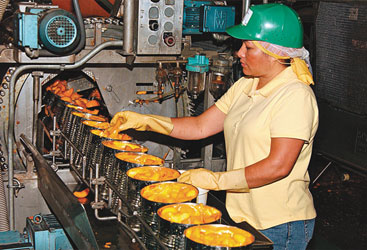
The peaches are transported to a cannery where they are processed within 24 hours to lock in nutrients.
"Our family has been doing this for generations and we take pride in putting out a good product," Micheli said. "I invite everyone to try canned peaches. I am so proud of the products and that they will meet everyone's nutritional needs."
As two of the Golden State's more than 500 cling peach growers, Micheli and Laney contribute to an annual cling peach production of about 400,000 tons per year—nearly all the nation's crop of canned, bottled and packaged peaches.
While cling peaches may be eaten fresh off the tree, their structure makes them better for processing to be used year-round. A cling peach is typically firmer than the freestone variety, "clings" to the pit, is yellow through the fruit and has less of a blush color on the skin. Freestone peaches are sold fresh, separate more readily from the pit and have red flesh around the pit cavity.
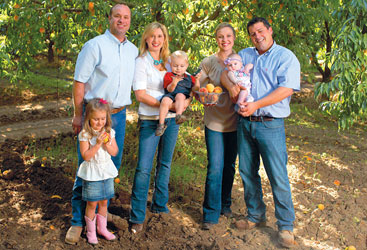
Anthony and Melissa Laney, with daughter Sofia and son Jack, and Candice and Justin Micheli, with daughter Olivia, continue the family farming legacy that dates back to the 1920s.
Cling peaches are handpicked at the peak of ripeness—usually from late June through early September—and within 24 hours are processed at a local canner with the nutrients locked into the container. The cousins' fruit goes to Lodi-based cooperative Pacific Coast Producers, the leading private label retail packer in the country for fruit.
"Studies show that processing the peach actually improves its nutritional characteristics, including increasing beta-carotene and lycopene," Laney pointed out.
While growers are happy to deliver a quality product to consumers, they face many challenges, including increased competition from foreign markets, according to California Canning Peach Association President and CEO Rich Hudgins. He reports that China supplies nearly 70 percent of the imported peaches coming into the U.S.
"Understandably, as the consumer goes down the aisle in their supermarket, when they see a familiar brand, nobody thinks to turn the container over and look for the fine print that would identify an imported product," Hudgins said. "In some cases, Chinese peaches are being sold under labels that are familiar to consumers. So, it is important to check the label and make sure it is California or U.S. grown."
The chef who owns a popular Live Oak restaurant doesn't need to check the label on the canned peaches he uses: His family and neighbors grow them.
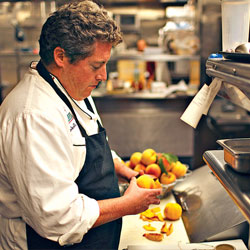
Chef Angelo Micheli uses cling peaches—both fresh and canned—from his family's farm.
The chef is Angelo Micheli, Justin's brother. With no interest in farming but a strong tie to the community, Angelo left for San Francisco then returned home with a degree from the California Culinary Academy. In 2007, he took over Pasquini's, the old grocery and gas station property that in the early 1970s had been transformed into a restaurant. Today, at the site made popular by previous generations, Angelo has revitalized the restaurant into a place known for Italian cuisine, steaks and pork chops (www.pasquinisfinefood.com).
"I grew up loving to cook. I learned from my father mainly and my aunts, family meals and old recipes," he said. "It is fun to come back and build on what they did for us. Plus, it is fun to see our own families grow and have something that we're very proud of."
He tries to incorporate as many canned peaches into his menu as possible—including a pork chop with a brandy peach glaze and a peach Melba with spumoni ice cream, canned peaches, raspberry sauce and whipped cream.
The three cousins, who are married with families of their own, recognize the commitment and hard work of previous generations and remain dedicated to continuing what their family started nearly 90 years ago.
"We all grew up together, learning the same values, experiencing the same opportunities. We are all very grateful for what opportunities we've been given," Justin Micheli said. "We all sense that there is something to prove—the continual success of the family legacy—so we must leave it in a better position than it was given to us. We must leave that same opportunity."
Christine Souza
csouza@californiabountiful.com





.svg.png)
