

Pumpkin pros
Fall 2025 California Bountiful magazine
Family farm specializes in autumn’s iconic squash
Story by Linda DuBois
Photos by Tomas Ovalle
Each fall, kids and adults alike set out to find the perfect pumpkin—whether for carving into a jack-o’-lantern or adding to a festive fall display.
A longtime farming family in San Joaquin County is helping ensure they’ll have plenty of great options.
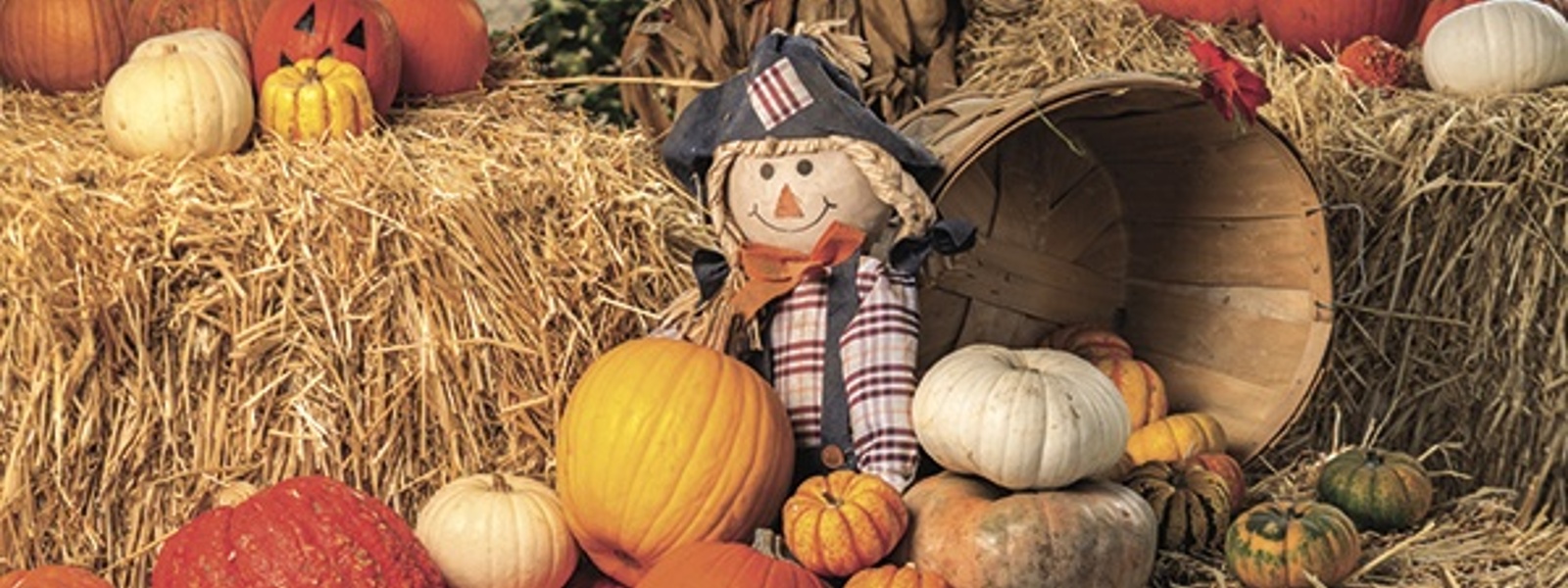
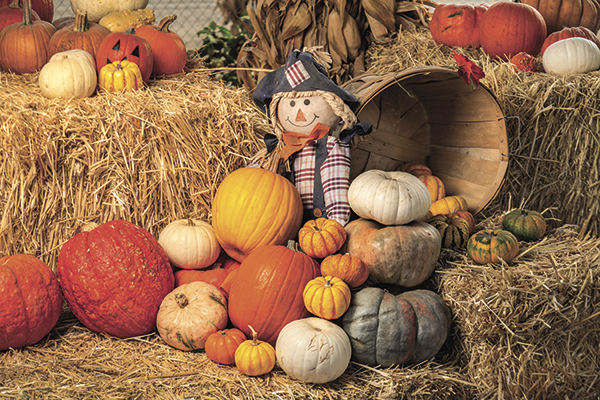
“We grow them from the size you can hold in the palm of your hand, to 1 to 2 pounds, to all the way up to 150 or 200 pounds, in all shapes, sizes and colors,” says Bryan Van Groningen, co-owner and vice president of crops and soils at Van Groningen & Sons in Manteca.
The farm grows 55 different pumpkin varieties for wholesale distribution under the Pamper’d Farms label—up to as many as 10 million of them per year, according to Van Groningen’s rough estimate.
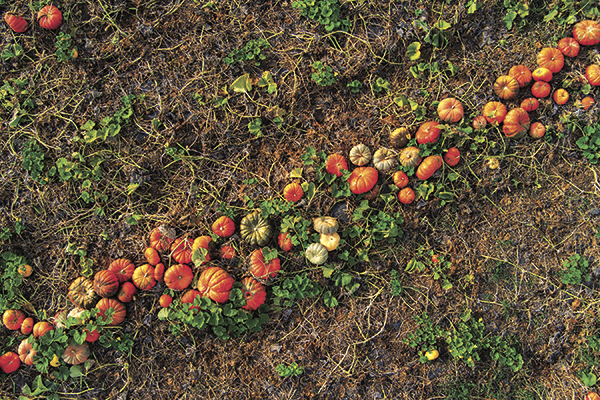
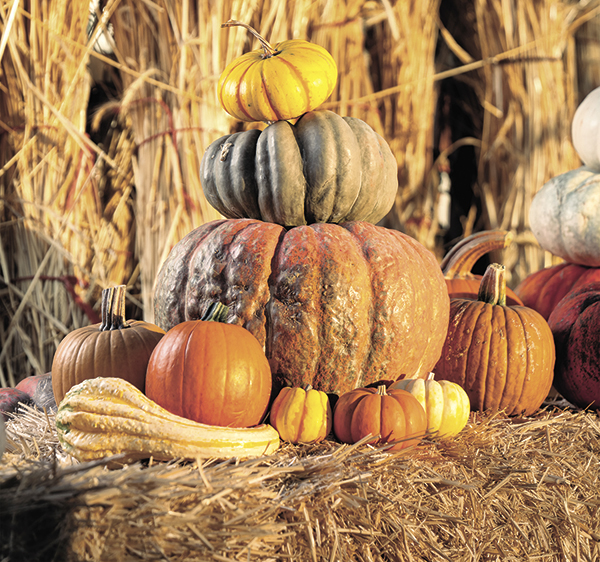
Besides orange, they come in bluish-gray, pink, yellow, pearl white, deep reddish orange, all shades of green, black and even multicolored.
“I’d say we have every color except for maybe purple,” Van Groningen says.
Something for everyone
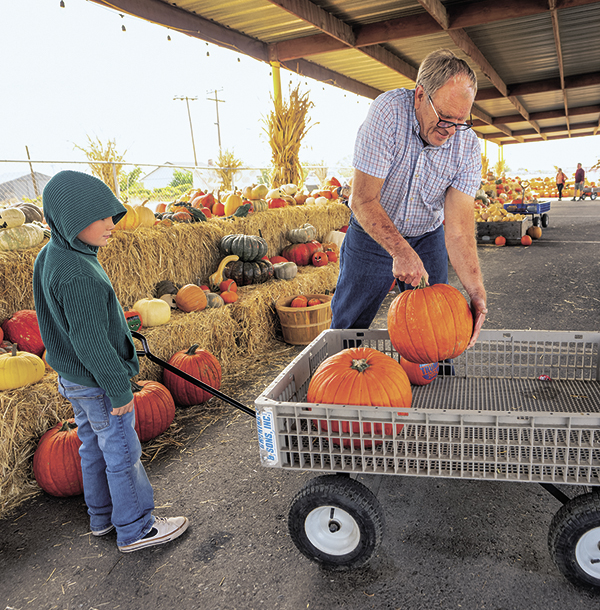
Customer preferences run the gamut, Van Groningen says. Most want traditional carving pumpkins—medium-sized, orange and perfectly round. Others want pie pumpkins or attractive varieties for a fall display. Yet, some gravitate toward the ugliest ones they can find.
Varieties include the Knucklehead and Warty Minion, both covered with unsightly bumps; the Fairytale, flat and round with deep ribs; the Big Mac, weighing in at up to 120 pounds; the Lil’ Tiger, white with colored stripes; the orange and yellow speckled Sparkler; and the solid white Snowball.
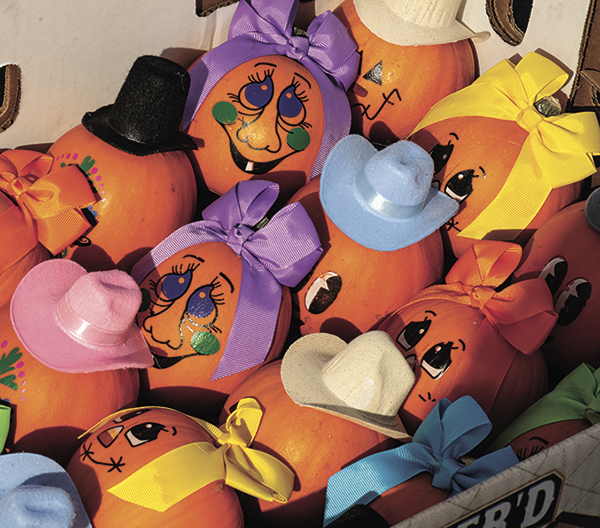
Since 2023, the farm has offered a new line of predecorated pumpkins called Pamper’d Posse, with computer-generated faces and other images stamped onto the rinds.
While a few Pamper’d Pumpkins are set aside for farmstand visitors, most are sold through chain stores and pumpkin lots, and often appear in fall displays at businesses and offices across the country.
Multigenerational
The farm traces its roots to 1922, when Henry Van Groningen Sr. started a dairy in California shortly after emigrating from the Netherlands. In 1929, the family moved to Ripon, where Henry and his sons started another dairy and expanded into row crops by 1939.
They grew canning pumpkins until the 1960s, when their focus turned to ornamental varieties.
Today, the fourth generation has taken over: Bryan Van Groningen and his cousins—Ryan Van Groningen, president; Jason Van Groningen, vice president of farming operations; and Paul Hiemstra (a cousin-in-law), chief financial officer.
They run a diversified 5,000-acre farm, raising beef cattle and growing crops such as almonds, corn, alfalfa, oats and wheat, specializing in pumpkins (1,700 acres) and watermelons (1,000 acres).
Approximately 100 full-time employees are supported by around 500 seasonal workers during the busiest nine months of the year.
Their recently retired parents serve as consultants, “looking over our shoulder and giving us advice,” Van Groningen says.
Perfect for pumpkins
His great-grandfather picked an ideal spot for pumpkin growing, Van Groningen says.
“We get the warm temperatures in the daytime and cooler nights … and the plants thrive in those conditions,” he says.
California growers produced 153 million pounds of pumpkins in 2023, valued at $30.5 million, according to the California Department of Food and Agriculture. And while pumpkins are grown in most counties, San Joaquin accounts for about half the state’s acreage (2,100), followed by Monterey (362) and Santa Barbara (310).
“This county supplies about 80% of the pumpkins sold and marketed in the whole state of California,” Van Groningen says, adding that his county’s claim to fame is it’s the nation’s second-largest county for pumpkin production, with the first being in Illinois, known for its edible varieties.
The perfect conditions inspire seed breeders to use the farm for trials of new pumpkin varieties.
“We put about 1 acre aside, and we plant about 60 different trial varieties,” Van Groningen says. The farm then works with seed company representatives to evaluate performance.
Van Groningen says these partnerships give the farm a first look at the new varieties being developed.
From farm to market
The farm sometimes harvests seeds to grow transplants at a nursery, but about 80% are mechanically planted directly in the field from seed, from April through late June. Different varieties take anywhere from 75 to 130 days to produce fruit.
Harvesting starts in late August, in time to get to market by Labor Day weekend, and continues to October, when there’s a “mad rush” before Halloween.
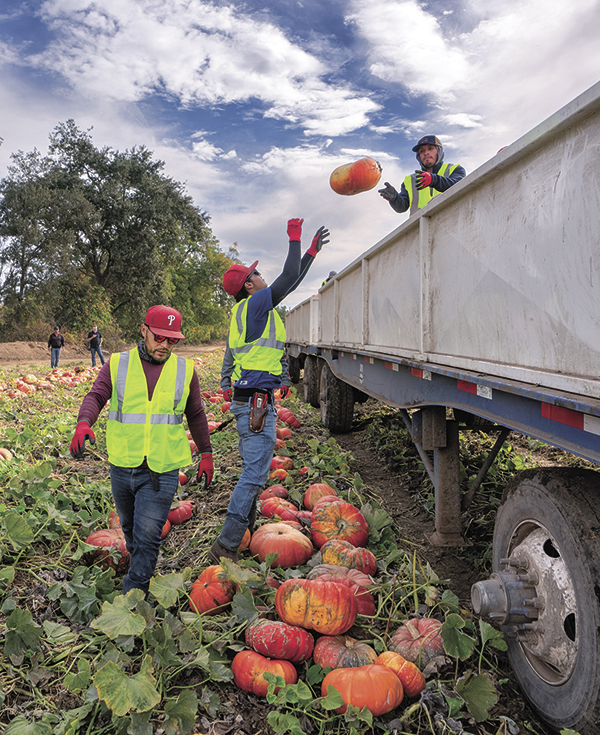
When the pumpkins are the right size and color, a crew goes through the field, hand cuts each pumpkin from its vine and leaves it in the field for the stem to dry. The next day, a second crew hand loads the small pumpkins into bins and the large ones into truck trailers.
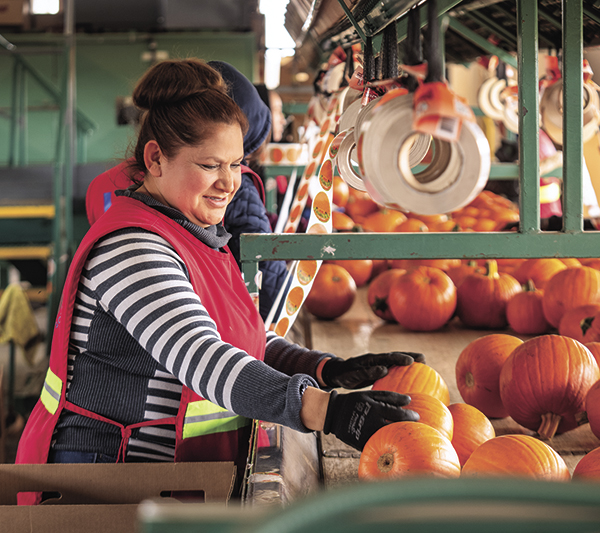
About 20 to 40 trucks per day transport the pumpkins to the on-farm packing shed, where they are weighed, logged and then placed on a conveyor line, where some are dusted off and others are washed, dried and coated with wax to make them shiny.
“We make sure they’re all clean and presentable, because, for pumpkins, it’s kind of a beauty contest. You have to have pretty pumpkins to catch people’s eyes,” Van Groningen says.
Meatier, edible varieties, such as Fairytales or Pie Pumpkins, are labeled with stickers that include recipes.
They are then sorted into boxes and shipped.
Damaged pumpkins unsuitable for sale are either fed to the farm’s cattle or picked up by a company that turns them into animal feed.
Challenges and rewards
Pumpkins can be tricky to grow, Van Groningen says.
They’re averse to temperature swings and a target for pests such as aphids and rodents.
They also require fresh soil, so the farm avoids planting them in the same field for more than two consecutive years.
There’s a whole other challenge in juggling 55 different varieties.
“It’s kind of a real big puzzle trying to put the planting schedule together and making sure everything’s done at the right time and grouped together in the right field,” Van Groningen says.
In between all the work, the staff makes time to host visitors, including school classes. They also work with the California Foundation for Agriculture in the Classroom and San Joaquin County AgVenture on various educational materials, including virtual farm tours.
“I feel really fortunate to be in the situation I’m in, even though it is very tough and difficult work,” Van Groningen says.
“Growing pumpkins is not easy,” he adds. “Sometimes I wonder, ‘Why am I doing this?’ But then when you get to the fall season and you see how much joy and fun the kids are having, and that our products are one of the reasons, it’s rewarding. Getting to that point is a bit difficult, but once you’re there, you can sit back and think about how all that hard work paid off.”
Spice up your pumpkin knowledge
Here are a few lesser-known facts about fall’s iconic squash from the U.S. Department of Agriculture.
Coming from the Greek word “pepon,” meaning “large melon,” pumpkins and other squash, gourds and melons are part of the Cucurbitaceae family.
Pumpkins are indigenous to North America and have been cultivated since at least 7,500 BCE.
Pumpkins are a popular centerpiece for Halloween and Thanksgiving, but they’re also common in cooking and decorating for Sukkot, also known as the Feast of Tabernacles, a week-long Jewish festival in late September or October that celebrates the fall harvest and commemorates the Israelites’ 40-year journey through the desert after the Exodus from Egypt.
Miniature pumpkins weigh less than 1 pound and are used for decorative purposes. Giant pumpkins exceed 25 pounds and some can grow to more than 1,000 pounds.
Every part of a pumpkin is edible, including the root, stem, leaves and seeds—but may not be enjoyable.
Pumpkins are rich in vitamins A and C, benefiting vision, skin and the immune system. Pumpkin seeds are a source of zinc, vitamin E and healthy oils.





.svg.png)
