

A life of legacy
March/April 2023 California Bountiful magazine
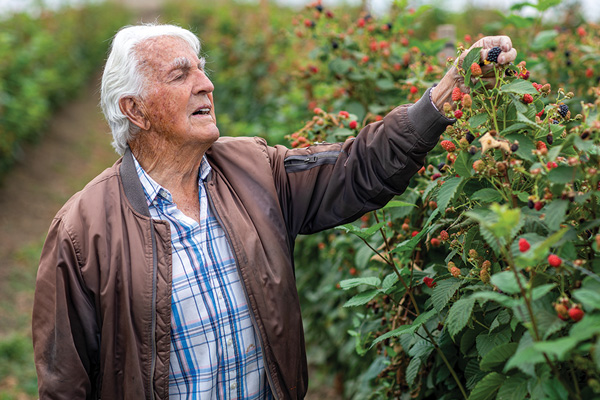
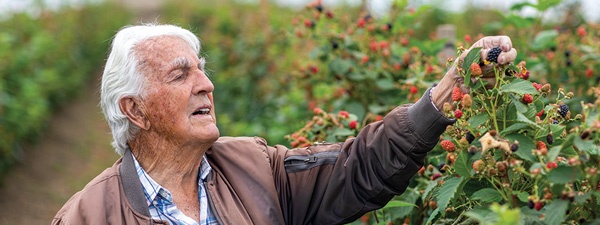
Guy George, 92, has had a huge impact on the land, other farmers
Story and photos by John Beck
At 92, Guy George has heard it all.
“A friend of mine likes to say, ‘There’s only one thing older than you, Guy, and that’s the dirt you farm.’”
He takes it as a compliment. Tilling the rich Pajaro Valley soil for the past “70 or so years,” he’s seen the produce business grow from small family farms to large operations that span the globe. Where once there were apricot and apple orchards surrounding Watsonville, now there are sprawling berry farms and vegetable fields.
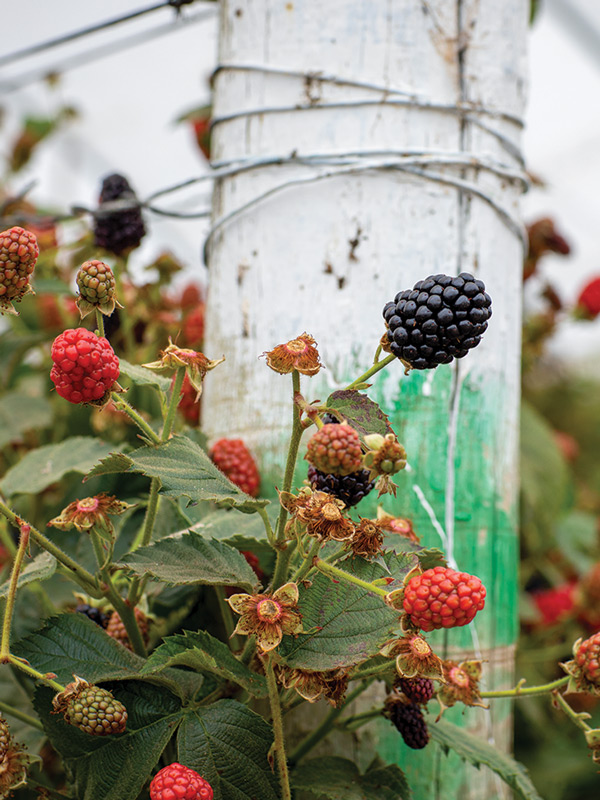
Over the years, he learned the hard way that “a few things work and a lot of things don’t—that’s the nature of farming.” In the ’60s, he sold cabbage under the “King George” label, with his name emblazoned on crates he drove past midnight to deliver to Bay Area wholesale markets. In the ’80s, he turned to strawberries and blackberries. He even tried his hand at organic farming. But, for the past 25 years, he’s been farming berries for Driscoll’s and “it was by far the best decision I ever made,” he says.
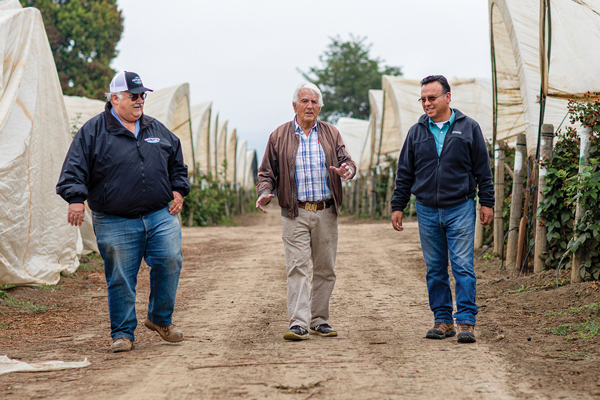
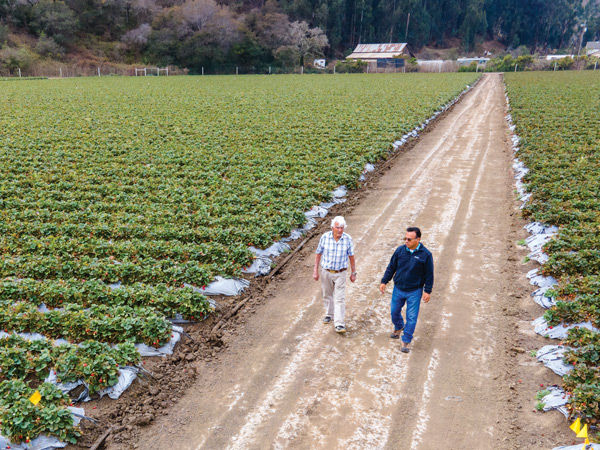
On a recent drive down San Juan Road in Watsonville, George and his Rancho Alitos business partner Arturo Diaz pulled over near a flower warehouse. In the distance, crews were working a 75-acre Rancho Alitos strawberry farm.
“I remember when this was all apples,” says George, standing in the dusty parking lot, his gold “Guy” belt buckle glistening in the sun. The flower warehouse was once an apple cannery where his father worked as a foreman. A few hundred yards behind it, he and his family lived in a small house.
“I was around 4 years old at the time and I would run down to watch the freight trains go by. On top, there were hundreds of men traveling from one place to another because of the Great Depression. They were called ‘hobos’ and they were from Arkansas, Oklahoma, Texas, Tennessee,” he recalls.
“They would all wave to me. They were on the rails looking for a job. That’s when I realized how important this valley is—that people came from all over to work here.”
Where it all started
Born in Watsonville to first-generation Portuguese immigrants, George learned early on that hard work was the key to success. At 12, he worked as a school janitor, later washing dishes in a local restaurant. After graduating from Watsonville High School, he spent several years in the U.S. Navy before returning to farm the valley and take classes at San Jose State University, where he graduated with a business degree.
He started out farming fruit trees, but it was cabbage that caught his attention early on. After several years of selling to suppliers, he decided to go out on his own and create King George cabbage—a royal idea suggested by the carton maker.
“I had been struggling, not making very much money, and it seemed like the people who were handling the product couldn’t sell it for any extra money so we would have a profit,” he says. “So, I decided I would do my own marketing and drive it to San Francisco and Oakland wholesale markets myself.”
Later, he ventured into organic berry farming, but it didn’t pan out when “the yield wasn’t good enough.” When Driscoll’s took a chance on him back in 1998, he started small and built up to around 75 acres of strawberries and 75 acres of blackberries.
“It’s only been in the last 25 years that I’ve really been successful,” George says. “All those other years it was just a struggle.”
Inspiring mentor
More than his work in the fields, George’s lasting legacy will be his influence on younger generations of Pajaro Valley farmers who grew up watching him face Mother Nature season after season.
“I think what they were impressed with was my determination,” he says. “I was doing everything on the farm—and the harder you worked the more chance you had of being successful. But you had to work hard.”
In a speech he gave last year, honoring George as the Santa Cruz County Farmer of the Year, Tom AmRhein said, “Guy is living proof that a little hard work might kill you, but a lot of hard work won’t.”
As a boy, AmRhein watched George do everything around the farm, recalling, “He drove tractors. He drove trucks. He got dusty. He got muddy. He got oily and greasy.”
Today, AmRhein is vice president of Naturipe Berry Growers, a Salinas-based marketing cooperative.
Dick Peixoto, also inspired by George, uses the word “perseverance” to describe his mentor. “I wouldn’t be here without Guy,” he says, leaning against his pickup truck in the middle of a Rancho Alitos blackberry farm. “When I needed a trailer to move a tractor, Guy was there. When I needed a tractor to help cultivate, Guy was there. I remember once I had money to rent the pipe, but I still needed a pipe trailer to transport it, so once again Guy was there to help.”
Today, Peixoto owns Lakeside Organic Gardens, farming 45 crops on 48 parcels on 1,800 acres in Watsonville. He also farms another 1,100 acres in Imperial Valley.
“You hit bad times and so many people give up. It was never an option for Guy. His motto is: ‘If you just keep going forward, times will get better.’”
Life changer
But possibly the most life-changing mentorship George fostered was when he took a chance on a young strawberry picker who showed promise in the fields more than four decades ago.
“I didn’t speak a single word of English,” Arturo Diaz remembers.
“And I didn’t speak a single word of Spanish,” George adds.
“So how we understood each other, I don’t know, but we figured it out,” Diaz says.
Born in Jalisco, Mexico, Diaz came to the U.S. at 13 and started working in the fields. Maybe it was his eagerness to learn or his ability to weld any kind of equipment, but there was something that made George give him more and more responsibilities around the farm.
“I learned things from him that I never thought I would learn,” Diaz remembers. “Like going on top of the tractor when I didn’t know how to drive. He would say, ‘Just keep going, and move this and that. You’ll figure it out.’”
In 1998, they became partners, forming Rancho Alitos, and they’ve been in business farming berries ever since.
“One thing about farming is, once you make friends, you keep them for life,” George says.
Over the years, he’s seen the cost of farming grow exponentially. He remembers when there were 33 conventional lettuce farmers in this valley. Now there are six.
“I can’t imagine being a young farmer starting out today. It’s almost impossible, unless they have a father or someone to bankroll them. The equipment is just too expensive,” he says. “But there’s nowhere else in the world I would rather farm, so you make it work however you can.”
Farmer's early ventures
resemble a movie script

When farmer Tom AmRhein inducted Guy George as Santa Cruz County Farmer of the Year last year, he offered a glimpse into his mentor’s late-night movie watching habits and his former late-night trucking forays all over Northern California.
“Guy will tell you that a film noir called ‘They Drive by Night,’ starring Humphrey Bogart, was a pretty good description of what Guy went through with his cabbage,” AmRhein told the crowd.
The 1940 Warner Bros. film follows two brothers trying to make a go of it as independent truckers, running produce up and down California highways at all hours. Spoiler alert: One brother loses an arm and the other is framed for murder, as the film depicts a dark underbelly of California’s agriculture transportation business during the era.
It was adapted from the 1938 novel, “Long Haul,” by Fresno-born author A.I. “Buzz” Bezzerides. One bustling cannery scene, where fish is loaded into trucks, was filmed at Wharf No. 2 in Monterey, not far from where George once delivered produce to Monterey Bay Shipping Co. in Castroville.
When he got into farming in the ’50s, George says he had no idea it would involve late-night drives, hauling his King George cabbage up and down Bay Area highways, unloading at rough-and-tumble San Francisco and Oakland wholesale markets in the ’60s. But you did whatever it took to get by, he says.
Once a week, he even delivered cabbage to Campbell’s Soup in Sacramento.
“We laugh about it because we would be driving trucks—he’d be driving to Castroville and I’d be driving to Moss Landing—hauling produce at 10 and 11 o’clock at night, trying to get the last loads in,” says farmer Dick Peixoto, who learned the ropes from George at an early age.
George remembers trucking produce well past midnight many times. “Back then, you’d move pipe, do all the irrigation yourself, spend all day harvesting. Then after the crew left, you’d load up the truck and head out on the road to deliver to wholesalers.
“Back then, you did whatever you had to do to keep the cash flow going,” he says, sounding almost like a character in a film noir.





.svg.png)
