

A call to nourish
Winter 2025 California Bountiful magazine
Eye-opening travels inspire surfing musician to learn and teach farming
Story by Linda DuBois
Photos by David Poller
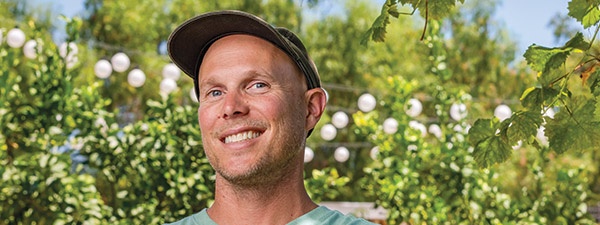
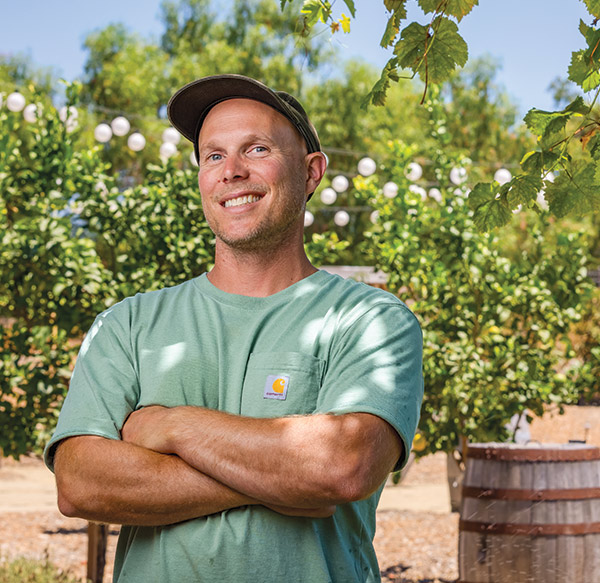
Aaron Flora grew up in Orange County’s Huntington Beach, enjoying a comfortable life of hiking and surfing in the beautiful natural surroundings and going home to a table full of locally grown nutritious food.
While still in his teens, he became the drummer for the successful pop-rock band Hellogoodbye.
He “took it all for granted” until his 20s when he started traveling abroad on surfing excursions. The crushing poverty he witnessed in some countries moved him to reflect on the contrast to his own life.
“I realized it was just so unfair and I wanted to help,” he says.
So, he and his friends decided they would incorporate a higher purpose into their surfing trips. “We’d also try to see what the community needed and help them out,” Flora says.
One of their favorite destinations was a remote coastal village in Panama.
“A big issue down there was malnourishment,” Flora says. The villagers couldn’t afford to buy produce nor were they educated on the importance of a balanced diet. So, they subsisted primarily on fish and rice. The resulting health problems forced many in the community of mostly manual laborers to retire at about age 40.
“The area had great weather and so much land, and it got me to thinking, ‘Maybe I should try to implement farms out here to get some vitamins in these guys’ diets.’” There was only one problem with that idea: He didn’t know a thing about farming.
“That’s how I decided to become a farmer,” he says. “I figured if I could learn how to grow food, I could teach others to do so wherever I went and that could help solve this issue of food scarcity,” Flora says.
A new mission
In between touring with Hellogoodbye and other bands, he threw himself into his new calling, learning everything he could about different methods of farming.
He later returned to the village in Panama and helped residents start a farm, which soon provided them with not only nutritious food but a source of income when they began selling produce to nearby towns.
Flora’s passion grew into leading philanthropic tourism groups to countries around the globe and “spreading the agricultural gospel.”
But after about five years, he reassessed the impact he was having. “I was just one person building and teaching, but if I had my own farm near home in Orange County, I could train others to go do what I was doing, and then we could use what we produced to feed food-insecure people in our area.”
So, he formally left his traveling musician days and focused on this new dream.
When the mayor of Anaheim took notice of a farm Flora had built for the local Salvation Army, Flora used the inroad to pitch his urban farm idea to city leaders. They immediately jumped on board and in 2014, they signed a contract for Flora’s nonprofit, Renewable Farms, to lease a 1-acre plot on city property. With financial help from a local business, Riverbed Farm was built in about six months in the heart of Anaheim.
In 2020, Renewable Farms built a second farm, Gold Coast Farm, 25 miles away on 2 acres of city property in Aliso Viejo.
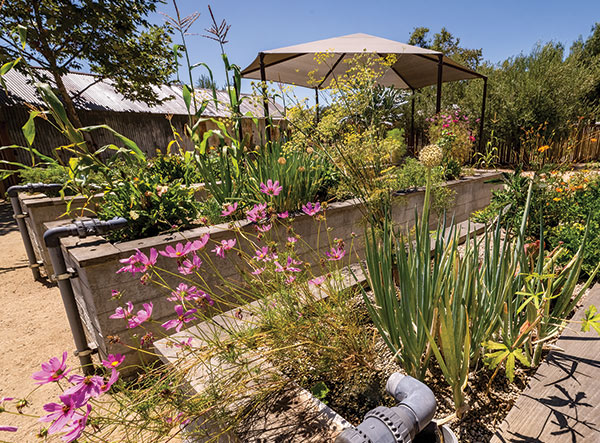
Between them, the farms have several varieties of fruit and nut trees, egg hens, soil plots for herbs and vegetables and aquaponic beds that produce both plants and fish, netting about 2,000 pounds of organic food each month, all given away to low-income families.
Beyond feeding people
Flora and three other employees manage Renewable Farms. Interns and volunteers help them with farm work. Besides occasional grants from local organizations, the nonprofit is self-funded.
“When I started the farm, I thought I was going to have to sell produce and give only some of it away, but people started approaching me and wanting to get married at the farm,” he says. Now, the two farm sites host more than 100 weddings per year, charging from $2,000 to $7,000 each.
Other funding sources include Flora’s offsite consulting for schools, hospitals, churches, community groups and homeowners on sustainable agriculture. He also builds customized aquaponics systems, chicken coops and raised beds.
“Usually, people just reach out to me,” Flora says. “I always have a project like that going on.”
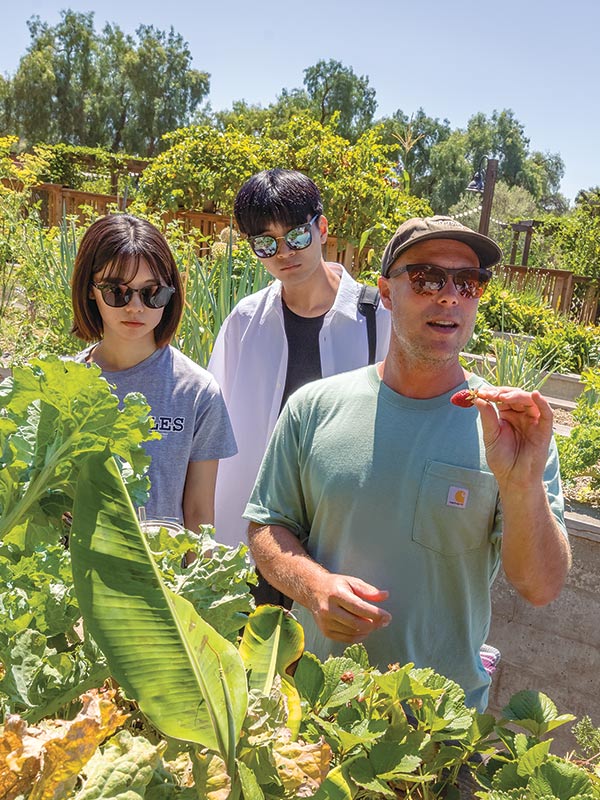
Both farms offer educational workshops, internships for students or adults interested in farming, field trips for schools and youth clubs, and hands-on work programs for veterans and people who are unhoused or have special needs.
They learn about water conservation, managing pests, composting, plant maintenance, caring for chickens and more.

Grateful partners
Connie Lawrence, a life-skills coach for Easterseals, takes a young man with an intellectual disability to the farm for four-hour shifts twice a week. His parents have noticed how much he benefits from these stimulating outings, Lawrence says.
“He really likes to do the farming. He likes to get his hands dirty and show me his favorite vegetables,” Lawrence says. “We do harvesting, cleaning up, shoveling. Sometimes we feed the chickens.”
He especially enjoys harvesting because he can take the food home. Passionate about cooking, he often talks with Lawrence about what he’d like to make with the harvests and spends his work break looking up cooking videos online.
Another fan of Renewable Farms is Nathan Zug, who runs Love Anaheim, a nonprofit that matches volunteers with community service projects. One of its programs, Better Way Anaheim, works with people experiencing homelessness. Each day, a participant receives on-the-job training and coaching, is fed lunch and given a $60 store gift card. They also are eventually linked to a steady job and to services to help end homelessness. The program is funded by the city of Anaheim with a federal grant.
Hundreds of the program’s clients have participated at Renewable Farms, usually about five at a time accompanied by two staff members, Zug says.
“Everybody likes to farm. In fact, people request to go back there,” Zug says. He adds that clients say the farm is a peaceful setting and they feel good about growing food for people who need it.
Meanwhile, Flora still takes overseas trips when he can, but now with the two thriving community-service farm sites and consulting projects, as well as a wife and 1-year-old daughter at home, it’s more difficult to get away.
When reflecting on the impact Renewable Farms has had on his community, Flora says he’s still amazed by how it all transpired.
“It was just very organic how it all kind of came about. I didn’t set out to become a farmer. I went to school to become a teacher and before that and after college, I was a musician. I thought I was going to be a rock star. And then I just got into farming and one thing led to the other and now I’m the director of this nonprofit. It’s interesting sometimes how things pan out.”
Farmer a fan of symbiotic growing systems
When Orange County resident Aaron Flora would travel to developing nations to build farms for impoverished residents, he tried to gear each growing method to the specific location.
He became particularly intrigued by aquaponics for dry terrains. This water-efficient system couples aquaculture (raising fish in tanks) with hydroponics (growing plants in water). The fish fertilize the growing plants and the plants clean the water for the fish.
“I also liked the idea of growing both vegetables and a protein source,” he says.
He got the idea from a man in his hometown who had built an aquaponic system for a church.
“He took me under his wing and showed me his version of aquaponics. He even helped me build my first system, and then after that, I just kind of took it and ran with it. Everything else was self-taught—a lot of reading, a lot of YouTube. There weren’t a lot of aquaponic resources out there, so I just studied fish and plants and bacteria because those are the main elements,” Flora says.
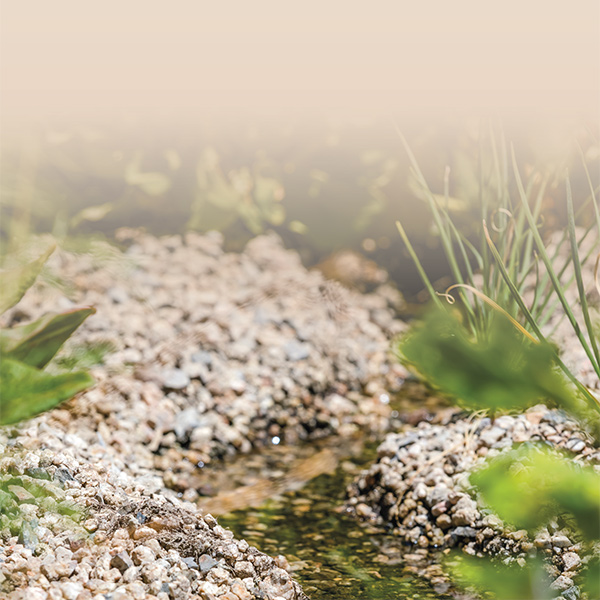
“There are a ton of ways to do aquaponics, just like there are a ton of ways to farm in general. I use an ebb-and-flow method and I grow in gravel. I fine-tuned the process to make it my own, with a lot of trial and error every time I built a farm. I would also get a lot of feedback from people running aquaponic systems, telling me the problems they were experiencing.”
For most of the 16 years he’s been in aquaponics, he would upgrade his systems and add new elements each year, until about six years ago, when he finally got everything perfected.
But aquaponics isn’t always the best solution, he says. “I went to Thailand and decided that aquaponics wasn’t the best fit, but in California where water can be scarce and land is sometimes an issue, especially in urban areas, aquaponics has been a really nice fit.”





.svg.png)
